

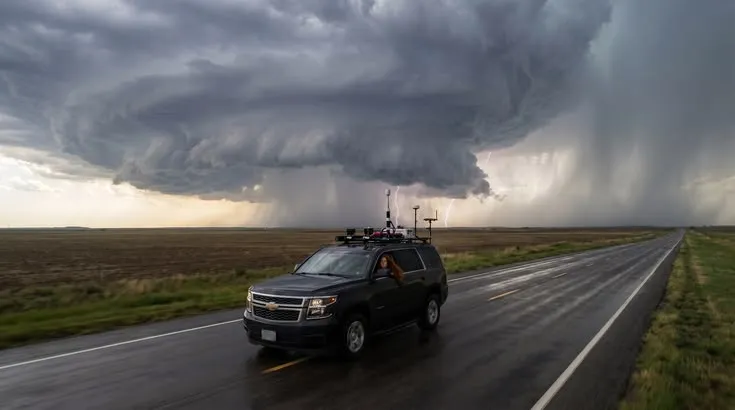
Tornadoes often dominate conversations about severe weather, but experienced weather enthusiasts know that the storm itself can be just as fascinating. A well-organized supercell can fill a huge portion of the horizon, changing shape and character as it moves across the Plains. For travelers exploring storm chasing tours USA 2027 learning to appreciate the larger storm can make a chase rewarding even when no tornado develops.
Supercells are particularly interesting because of their organization and longevity compared with many ordinary thunderstorms. Watching one from an appropriate location can reveal layers of cloud, areas of precipitation, changing light, and an impressive sense of scale. The experience encourages travelers to observe the entire sky rather than waiting for one specific feature.
What Makes a Supercell Different?
A supercell is a thunderstorm characterized by a persistent rotating updraft. This organized structure distinguishes it from many shorter-lived or less organized thunderstorms. That does not mean every supercell looks identical. Its appearance can depend on moisture, lighting, precipitation, viewing angle, and other atmospheric conditions.
For a first-time observer, the most striking feature may simply be the storm’s size. From a suitable distance across open terrain, its structure can appear far more extensive than expected.
Structure Can Be the Main Attraction
One advantage of observing storms across the Great Plains is the possibility of seeing more of their overall shape. Open landscapes and broad horizons can provide perspectives that are harder to find in heavily wooded or densely developed areas.
Travelers may notice towering cloud formations, a broad storm base, distinct precipitation regions, or other structural changes as the storm evolves. These features make supercells compelling photographic subjects. A tornado is not necessary for the scene to be visually dramatic.
Every Viewing Angle Tells a Different Story
Storm appearance can change significantly depending on where the observer is positioned. From one location, precipitation may obscure much of the structure. After repositioning, a broader portion of the storm might become visible.
This is why storm chasing involves continual assessment rather than simply stopping at the first place where clouds can be seen. The objective is not to get unnecessarily close. A more distant perspective can sometimes provide a clearer and more impressive view of the storm as a whole.
Supercells Reward Patient Observation
Travelers considering storm chasing tours 2027 should expect storm development to unfold over time. The most interesting structure may not be present immediately after a thunderstorm forms. Watching patiently allows visitors to notice how the storm changes. A cloud base may become more organized, precipitation can expand, and previously subtle features may become increasingly visible.
This progression makes the experience different from arriving at a fixed attraction. The subject itself is constantly evolving.
Light Can Completely Change the Scene
Lighting has a powerful effect on the appearance of a supercell. A storm under flat midday light can look entirely different when lower sunlight reaches beneath surrounding clouds later in the day.
Interesting visual conditions may include:
-
Sunlit fields beneath dark clouds
-
Bright cloud edges against a darker sky
-
Rain shafts illuminated from behind
-
Warm evening light across the landscape
-
Lightning within distant precipitation
-
Contrasting clear and stormy portions of the horizon
Photographers who watch the wider environment may find compelling scenes away from the most obvious part of the storm.
Not Every Supercell Produces a Tornado
This distinction is important for anyone new to storm chasing. A supercell can possess impressive organization without producing a tornado. Tornado formation depends on multiple atmospheric processes, and its occurrence cannot be promised simply because a severe or rotating thunderstorm develops.
Understanding this helps travelers avoid judging an impressive storm as unsuccessful. Supercell structure, lightning, cloud motion, precipitation, and changing light can provide a memorable experience independently.
Photography Benefits From Showing Scale
A photograph of clouds alone may not communicate how large a storm actually appeared. Including elements of the Plains can provide useful visual scale. Roads, fields, distant buildings, or the horizon can help viewers understand the size of the weather above them. Wide compositions are therefore often valuable when photographing organized thunderstorms.
Travelers can also document the storm at different stages rather than taking dozens of nearly identical photographs from one location.
Observing the Whole Storm Builds Understanding
Following a supercell can reveal how dynamic severe weather really is. Features that seem prominent at one moment may weaken, while another part of the storm becomes more visually interesting.
Guests can compare what they see with forecast discussions and learn why positioning decisions change during the chase. That broader observation turns the storm from a distant spectacle into an evolving weather system with a story that develops throughout the day.
Conclusion
Supercells demonstrate why storm chasing should never be reduced to the search for tornadoes alone. Their scale, organization, changing structure, dramatic lighting, and interaction with the Plains can make them remarkable subjects for both observation and photography.
With Storm Chasing Adventure Tours, guests can experience severe weather from a broader perspective, learning to appreciate the complete storm and the atmospheric changes that make every supercell encounter different.