

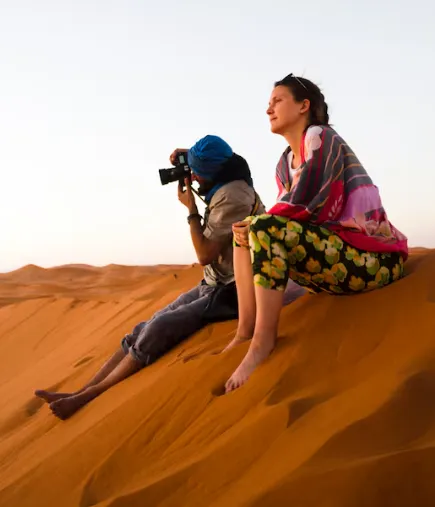
There are journeys that simply move you from one place to another, and journeys that change how you see a country. Fes to Marrakech desert tours belong to the second group. Over three or four days you leave a medieval medina, climb through cedar forests, follow palm-lined valleys, sleep among the Sahara’s dunes and finish in the red-walled city of Marrakech, all without retracing a road. Planned around local people and an unhurried pace, this crossing also delivers some of the most authentic Morocco tours available, and it sets a high standard for Morocco desert tours in general.
This guide shows what you gain at each stage of the trip and how to choose a tour that delivers it.
Why This Route Delivers So Much Value
The crossing covers roughly 700 kilometers and four distinct regions: the Middle Atlas, the Ziz and Tafilalet oases, the Dades and Todra valleys, and the High Atlas. Because the route is one-way, every kilometer shows you something new. Travelers also benefit from:
-
An early desert arrival: You reach the dunes on the first night, with a full evening and sunrise in camp.
-
A natural arc: Scenery moves from green highlands to desert to mountains.
-
A lively finale: Marrakech’s markets, gardens and rooftop terraces make a memorable last night.
-
Simple logistics: Both cities have international airports.
Stage by Stage: What You Gain
Fes: Context and Craft
Before you leave, spend time in Fes el-Bali, the UNESCO-listed medina and one of the largest car-free urban areas in the world. A licensed local guide can show you tanneries, weavers and metalworkers, giving you a cultural foundation for everything that follows.
The Middle Atlas: Fresh Air and Forest
Leaving Fes, the road climbs to Ifrane, an alpine-style town, and the cedar forests near Azrou, where wild Barbary macaques often appear beside the road. It is a cool, green contrast to the desert ahead.
The Ziz Valley and Merzouga: The Sahara Experience
South of Midelt, the Ziz Valley unrolls as a ribbon of palm groves and earthen villages. It leads to Merzouga and the Erg Chebbi dunes, where sand ridges rise more than 100 meters above the plain. A camel caravan carries you to a Berber-style camp at sunset for a traditional dinner, drumming and stargazing. At dawn, the dunes shift from gold to soft pink.
Todra Gorge and the Dades Valley: Drama and Hospitality
Limestone cliffs tower over a cool stream at Todra Gorge, a favorite place for a short walk. In the Dades Valley, family-run kasbah guesthouses offer home cooking and views over dramatic rock formations.
Ouarzazate, Aït Benhaddou and the High Atlas: Heritage
Ouarzazate, sometimes called the “Hollywood of Morocco,” leads to Aït Benhaddou, a UNESCO-listed fortified village once tied to caravan trade. The final stretch crosses the Tizi n’Tichka Pass, one of the highest roads in the country, before descending into Marrakech.
What Makes These Tours Truly Authentic?
The word authentic morocco tours appears in nearly every brochure, so look for specifics:
-
Local guides and drivers with regional roots who share personal stories, not scripts
-
Family-run riads, kasbahs and camps that keep income in local communities
-
Hands-on experiences, such as bread baking, tagine cooking or visiting a women’s weaving cooperative
-
Small groups or private travel, which allow spontaneous stops and real conversation
-
Responsible practices, including fair wages and sensitive photography
Ask operators for concrete examples. Detailed answers are a good sign, while vague promises of “real Morocco” are not.
Choosing Among Morocco Desert Tours
-
Camp type: Traditional tents, comfort camps with beds and bathrooms, or luxury suites with heating.
-
Group size: Private tours allow flexible stops, while small groups can lower costs.
-
Inclusions: Confirm accommodation, meals, camel ride, entrance fees and transport.
-
Guide and driver experience: Long mountain and desert roads demand local knowledge.
-
Recent reviews: Look for detailed feedback that mentions people and moments.
-
Pricing transparency: Ask about tips, drinks and optional activities.
The lowest price is rarely the best value. Very cheap offers often mean larger groups, rushed schedules or basic camps.
Three Days or Four?
Three days covers every highlight but involves long driving days. A four-day version adds a night in the Draa Valley or Ouarzazate, shortening the drives and leaving time for palm-grove walks, cooperative visits and longer meals. If your schedule allows, four is the more rewarding choice.
Best Time to Go
-
Spring (March to May): Mild weather and green valleys. The most balanced season.
-
Autumn (September to November): Clear skies and comfortable temperatures.
-
Winter (December to February): Pleasant days but very cold desert nights. Pack warm layers.
-
Summer (June to August): Extremely hot in the Sahara. Best for travelers who handle heat well.
Practical Tips
Pack a light scarf, sunglasses, sunscreen, sturdy shoes and a warm jacket for evenings, plus a power bank since charging in camp is limited. Take a small daypack to the dunes and leave your main luggage in the vehicle. Dress modestly in villages and medinas, ask permission before photographing people and carry small cash for tips. Leave a buffer night in Marrakech before any flight home.
Conclusion
Fes to Marrakech desert tours condense an extraordinary range of Morocco into one seamless journey: a medieval medina, cedar highlands, palm valleys, ancient kasbahs and Saharan dunes, finishing in one of the country’s liveliest cities. Built around local guides and family-run stays, they become genuinely authentic Morocco tours, and by comparing camps, inclusions and group sizes, you can choose the best of the many Morocco desert tours on offer.
Choose a reliable local operator, allow at least three days, ideally four, and leave room for the unplanned. In Morocco, that is often where the best moments happen.